

By going into a government shutdown rather than validating President Donald Trump’s lawbreaking with a vote for his budget even as the White House openly ignores parts of existing budgets, Democrats were finally acting like a real opposition. With large No Kings protests followed by resounding Democratic victories in state and local elections, it looked like the public approved. Then eight Democratic senators decided to fold, giving Republicans the votes to move forward in exchange for little more than Republicans saying they’ll hold a separate vote on healthcare that Democrats will presumably lose. That appeasement displays a dangerous misunderstanding of the moment, as if America still has a healthy rule-of-law democracy.
The Democratic Party is the one available vehicle for countering Trump’s authoritarian takeover. Pro-democracy Americans desperately need a real opposition, one that adopts a mindset more suited to the democratic backsliding we find ourselves in.
The normal democracy mindset says Democrats shouldn’t fight unless they have a clear path to a policy win. But that’s not possible, since the White House, with Congressional Republicans’ support, already claims the blatantly illegal power of rescission, usurping Congress’s Constitutional power of the purse.
Republicans control every part of the federal government, so why isn’t it their responsibility to govern? Why is it the minority’s responsibility to save Republicans from themselves, let alone in exchange for virtually nothing?
If Democrats kept holding out, they could have succeeded if:
Trump folds, credibly committing to follow budget laws. (Very unlikely, probably impossible.)
Republicans make tangible policy concessions, such as on healthcare, establishing a point of leverage Democrats could use if Trump reneges.
Republicans pass a budget themselves, using a simple Senate majority to change filibuster rules as they have multiple times before, which would give them full ownership of any ensuing problems, and signal to the public that Democrats oppose those problems. Plus it’d make it easier for Democrats to pass a new Voting Rights Act or Supreme Court reform if they ever regain power.
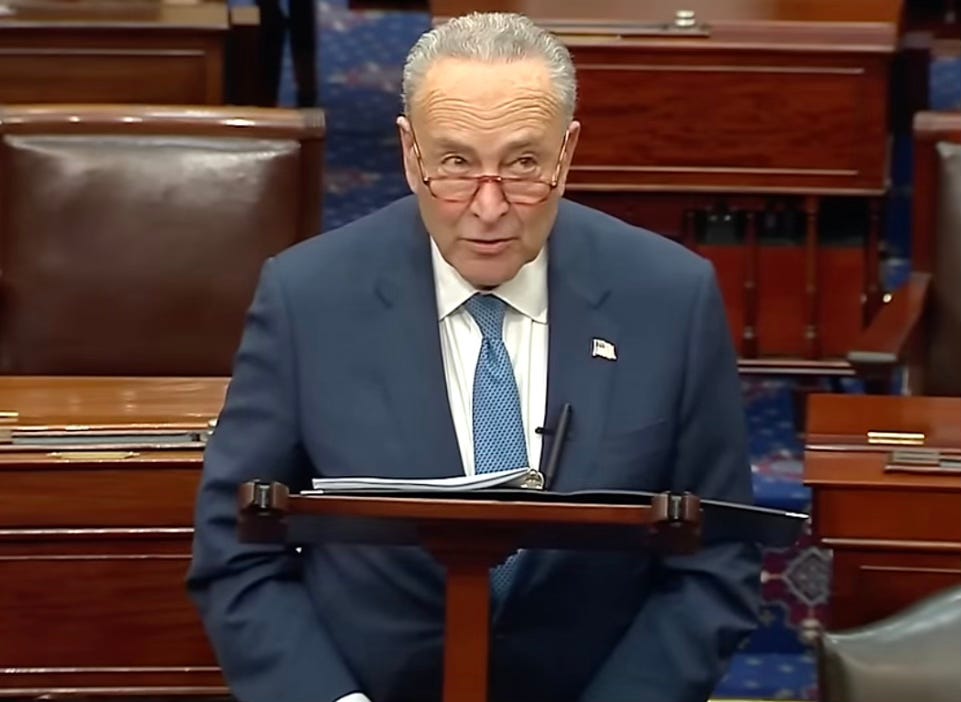
Instead of holding out for any of those, the Appeasement Eight—and by extension the whole Democratic caucus, since minority whip Dick Durbin is one of the eight voting to fold, and minority leader Chuck Schumer made no apparent effort to stop them—gave Republicans bipartisan cover, and established another point of leverage Trump has over Congressional Democrats. It arguably rendered the entire shutdown pointless, all pain for no gain.
That pain was real. Many federal employees—air traffic controllers, military members, park rangers, etc.—were missing or about to miss paychecks, and Americans were losing out on their services. The FAA grounded about 10% of flights at major airports, creating travel delays. Billions of dollars in SNAP food assistance payments were held up, raising serious risks of millions going hungry.
In a normal democracy it’d make sense to prioritize reducing that harm in the short term. But America doesn’t have one anymore.
Case in point: The law already requires the government to deliver SNAP benefits in a shutdown, drawing down a fund marked for that purpose. The White House refused, then defied direct court orders to distribute the funds, and was taking the case to the Supreme Court.
In a rapidly backsliding democracy, harm is happening no matter what. Therefore, preventing authoritarian consolidation is the most harm-reducing move.
The Democrats decided not to make Trump’s lawbreaking and rights violations their main pitch to the public, instead emphasizing healthcare premiums. And it appeared to be working. More of the public held Republicans responsible for the shutdown, and Trump’s net approval rating declined. Around 75% of Americans wanted Obamacare subsidies extended, including nearly half of MAGA voters. Among that 75%, Americans blamed Trump and the GOP for jeopardizing health insurance by an overwhelming 53 points.
In theory, Democrats could fight again when the stop-gap spending bill runs out next year, but they’d do so from a weaker position, having shown Trump that just a few days of disrupting air travel can get them to quit for nothing. And Democrats waited until after the 2025 election to fold, suggesting they knew it would bother voters, dampening enthusiasm.
But as a purely electoral question, folding on the shutdown probably isn’t a big deal. Republicans will get the damage to health insurance markets they want, Trump will continue breaking laws and violating rights, the economy will likely keep declining due to Trump’s tariffs and corruption, and Americans are more likely to take it out on the party in charge when they vote in Congressional elections next year.
But thinking that the next election is all that matters is part of the problem, more of that outdated normal democracy mindset. Even if Democrats win at least one house of Congress, it’ll be after another year of Trump degrading checks and balances, rendering it a weakened institution. They should be defending it now as best they can, instead of facilitating Trump’s destruction.
The main divide in the Democratic Party today is not between liberals and leftists, or moderates and progressives. Big wins last week for moderate former CIA officer Abigail Spanberger in Virginia and democratic socialist Zohran Mamdani in New York City shows the party has room for all of them, and is stronger for it. The main Democratic divide is between those who recognize Trump’s growing authoritarianism and want to fight it, and those who want to weakly acquiesce.
One of the Appeasement Eight, Sen. Jeanne Shaheen, explained that some Republican senators told her they’d work with Democrats after the government reopens, and the White House did too, “so now we’ll see if they’re really going to work with us.”
They won’t. Believing a vague promise from proven liars is willfully naive, like Charlie Brown telling himself Lucy won’t move the football again.
Another appeaser, Sen. Angus King, explained his decision with, “Standing up to Donald Trump didn’t work.”
Well sure, when you prematurely fold rather than see a fight through, you fail. And why should Trump opponents vote for anyone who thinks standing up to Trump isn’t worth doing?
The 2025 elections and the No Kings protests show that the public is with the fighters. So pro-democracy Americans should use 2026 to primary any Democrat from the Don’t Fight caucus and demand new Congressional leadership ahead of the bigger fight in 2028, when there’s a risk the Trump regime has consolidated enough authoritarian power that elections are not free and fair.
Thanks for the great analysis. I needed to read this today after following the news last night in a state of disbelief. Senator King's remarks in particular were a real gut punch. It is amazing how so many people outside politics can see so clearly what Democratic Representatives can't.