

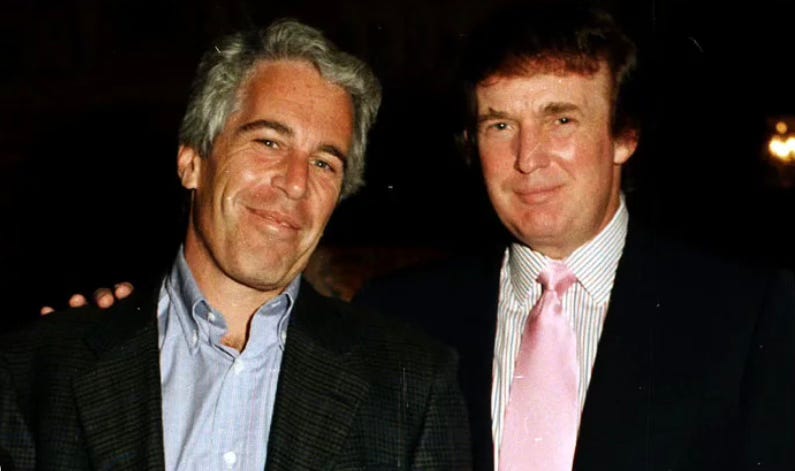
MAGA is fighting over Jeffrey Epstein, the disgraced financier and sex trafficker. Outsiders might scoff at that, but conspiracy theories about Epstein—especially claims that he didn’t commit suicide in jail, he was murdered to stop exposure of powerful clients—are a keystone to MAGA understanding of government, elites, and how the world works. Some leaders and influencers might have stoked those theories to manipulate their followers, but a bunch of the followers really believe.
Now the Trump administration has reneged on promises to release information from the Epstein investigation, claiming that there’s nothing new. Prominent MAGA figures are objecting, with some even calling for a special counsel. It’s a rare instance of the conspiracy theory mindset dividing rather than uniting them, and it’s making them confront a contradiction at the heart of the Trumpist movement.
To be a Republican in good standing today, you must believe, or at least go along with both:
A lot of powerful people in business, entertainment, and especially politics are involved with underage sex trafficking, using their power to cover it up. The best evidence that there’s at least something to this is Jeffrey Epstein. It must be investigated and exposed.
Known Epstein associate Donald Trump, who has been found liable for sexual abuse in court and bragged about barging into dressing rooms at teen beauty pageants, opposes sex trafficking and related malfeasance, perhaps even conducting a secret crusade against it. Those photos of him partying with Epstein, and his connections to rich Americans’ involvement with sex crimes more generally, do not matter, don’t ask.
This is an egregious instance of what George Orwell called “doublethink”: the ability to hold contradictory ideas at the same time. That propped up Big Brother in 1984, and it’s a core component of Trumpism. For example, he’s an incredibly strong leader no one dares cross and a poor, persecuted victim who needs your sympathy. Also, urban populations are scared weaklings who would quickly fold in a civil war, and cities are terrifyingly violent “no-go zones” where even heavily armed officers face dire threat.
Doublethink hasn’t been a political problem for Trump, and if anything has been an asset. It indulges and cultivates a mindset that rejects inconvenient facts, validates preexisting feelings, and encourages insinuation-drenched speculation.
Similarly, many misunderstand the appeal of Trump’s early slogan “he tells it like it is.” It doesn’t mean he’s honest about the evidence, it means he repeats voters’ BS back to them, acting as if nonsense they already believe is real.
A great illustration of this comes from a Bluesky user who goes by @opinionhaver. If a bunch of voters “believed that a creature called ‘Glonzo’ caused high power prices by chewing through transmission lines,” most politicians will “mumble something about hardening electric infrastructure,” while Trump promises that if he’s elected “the Marines will kill Glonzo.”
Vowing to kill Glonzo found fertile political ground, because tons of Americans are at least open to a conspiracy theory mindset, and most Republicans who aren’t have shown they’ll go along with anything. A 2023 YouGov study found that over 50% of Americans believe in at least one conspiracy theory—with JFK assassination theories leading the pack—while 41% say it is definitely or probably true that “there is a single group of people who secretly control events and rule the world together.” Moon landing, 9/11, and vaccine conspiracy theories all get 18% or higher, with Republicans consistently believing them more than Democrats.
Playing to conspiracy theorists is one way Trump expanded his electorate, turning out some Americans who usually don’t vote and winning over some who voted Democrat (or Green), such as the “all natural” woo woo type of antivaxxer. The conspiracy theorist mindset serves his attack on truth and reinforces the cultish qualities of his coalition, encouraging supporters to dismiss inconvenient news as “fake,” and to see themselves (and him) as victims, entitled to drastic action in response.
Conspiracy theorists are resistant to counterarguments, because their logic is built on rejecting Occam’s Razor, and theories can expand to recast contrary evidence as deception. Reinforcing that, Trump has Fox News and the rest of conservative media, X and the rest of the Online Right, the bully pulpit, and a corrupted Department of Justice — all repeating, validating, and adjusting the conspiracy theories, constructing a reality on the ever-shifting, lie-strewn landscape of Trump is Doing Good and What He Just Said is True.
With Jeffrey Epstein, that might have finally reached its limit. There’s widespread, organic, legitimate concern about Epstein’s crimes, and his long time in high society despite them. On top of that, many on the right fold it into their cause, from QAnon and the manosphere, to Republican Senators trying to score political points.
Trump and Co. pushed the Epstein story hard for years, playing to the conspiracy theory mindset.
In December 2021, JD Vance insinuated, “What possible interest would the US government have in keeping Epstein’s clients secret?” He followed up with “If you’re a journalist and you’re not asking questions about this case you should be ashamed of yourself. What purpose do you even serve?” In an October 2024 interview, less than a month before the election that made him vice president, Vance told podcaster Theo Von, “We need to release the Epstein list. That is an important thing.”
Similarly, FBI Director Kash Patel and Deputy Director Dan Bongino both accused the government of covering up the cause of Epstein’s death, and publicly called for release of the “Epstein list” before they got their current jobs. Empowering people like Patel and Bongino was supposed to expose the whole nefarious conspiracy.
Except in office, Trump officials keep promising but never delivering. This February, Attorney General Pam Bondi announced “you’re going to see some Epstein information released.” In March, she invited right-wing influencers to the White House to receive “The Epstein Files,” only to hand them a collection of documents already in the public domain. Bondi later promised it was just the start, and when Fox News asked about an Epstein client list, replied “it’s sitting on my desk now to review.”
But now Bondi says they won’t release any more information, and stands by a DOJ finding of no client list, no blackmail schemes, and no foul play in Epstein’s death. Patel has reversed entirely, publicly arguing that “the conspiracy theories just aren’t true, never have been,” and going on Joe Rogan’s podcast to urge people to stop asking questions.
Whether they were true believers and genuinely surprised by the absence of evidence, or post-truth nihilists who say anything for power, these Trump officials are in position to know, and they’re acting like the villains of conspiracy theories, insisting there’s nothing to see.
But we know there’s an investigation file. It contains things that fall short of admissible in court, and a reasonable guess is that the file has new information on Trump’s interactions with Epstein, which he doesn’t want people to see. At minimum, he would rather allow speculation than quell it by releasing the files, pleading with followers to “not waste Time and Energy on Jeffrey Epstein, somebody that nobody cares about.”
Except a lot of people do care, especially a loud subset of Trump supporters. It’s not a joke to them, or a manipulative lie to gain power, it’s real. There are grifters mixed in with those true believers, but enough of the believers are genuinely upset that some grifters see opportunity in sticking with the conspiracy theory instead of dropping it like Trump asks. It’s the first time they’re treating him like The Man, rather than an outsider fighting against the state.
And who knows what Elon Musk is thinking, but he’s been publicly criticizing Trump on Epstein, and his stint in the Trump administration—along with years of throwing pedophile accusations at people he doesn’t like—adds credibility. When Musk stokes the conspiracy theory, believers think that means he saw evidence. “This is a very big deal,” Musk recently wrote on X. “What the hell kind of system are we living in if thousands of kids were abused, the government has videos of the abusers and yet none of the abusers are even facing charges.”
It’s absurd that it took half a year into Trump’s second term as president to see him as part of the government he leads, responsible for the officials he appoints. But it’s also absurd that they’ve given him a pass on Epstein connections. Perhaps it took these celestial absurdities colliding to generate a real crack in the MAGA bubble.
In 2002, Trump called Epstein a “terrific guy” and said “he likes beautiful women as much as I do, and many of them are on the younger side.” In 2019, when Epstein died in federal custody, Donald Trump was president. The facility is managed by the Federal Bureau of Prisons, which is part of the Justice Department, led at the time by Trump-appointed, Republican-Senate-confirmed Attorney General William Barr. If there was any elite conspiracy to silence Jeffrey Epstein, they’re the logical culprits. At minimum, they were in the best position to have it investigated, and had a lot to gain from exposing any political opponents involved, but despite controlling the executive branch for almost a year and a half after Epstein died, did not.
That is usually more than enough to ignite conspiracy theorists’ speculation, but not here. You’re also supposed to believe someone else killed Epstein under Trump’s nose, and that this in no way reflects poorly on Trump’s competence. More doublethink. It doesn’t make sense, but that’s why this fits the term “cult of personality.”
And therein lies the hope: Some Trump supporters disillusioned over the Epstein case aren’t questioning a government leader or critically evaluating the news, they’re experiencing something akin to religious doubt. For the first time, they’re allowing themselves to consider the possibility that a bedrock belief might be less than fully correct. And if the leaders/community are wrong about that, maybe they’re wrong about other things too.
For religious doubters, the trigger can be a personal tragedy, or a positive experience with activity the religion forbids. For this cohort of Trump voters, it’s being denied the vindication they expected for years, and seeing Trump act exactly like one of their theory’s villains.
I don’t want to get my hopes up. This cult has roped doubters back in before, and can always fall back on hating the left (variously defined). But a big chunk of Trump voters care about Epstein and surrounding issues, and a subset of them are realizing Team Trump’s treated them like marks. The more who do, the merrier.
I'm pleasantly surprised to see Dems getting off their feckless asses and taking political advantage of this.