
The Sanctification of Derrick Bell
The New Yorker runs a hagiographic profile of the founder of Critical Race Theory

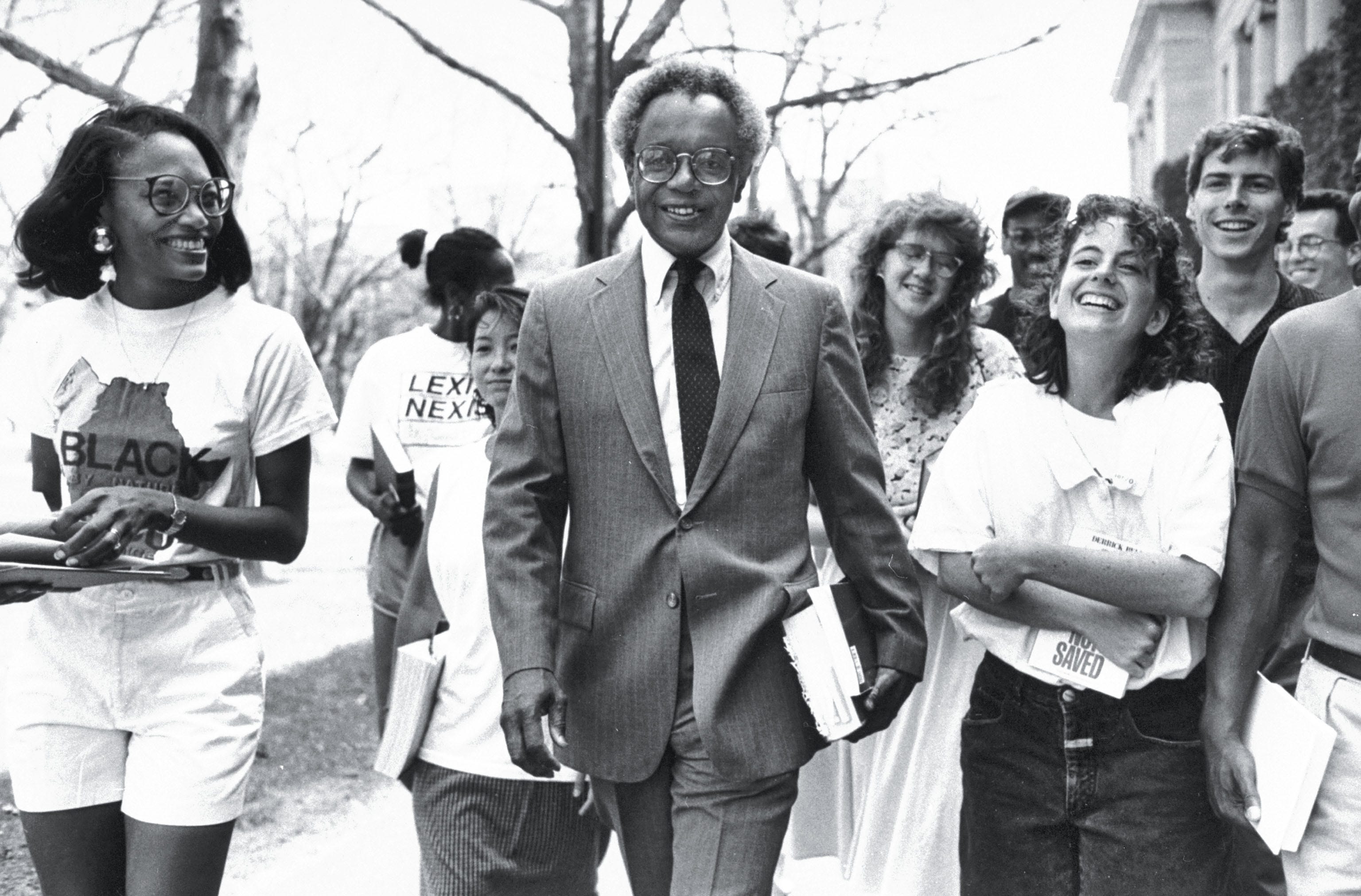
Amidst the ongoing debate over “Critical Race Theory,” The New Yorker recently decided to run a feature on one of its founders, the late lawyer, civil rights activist, and Harvard law professor Derrick Bell (1930-2011). But “The Man Behind Critical Race Theory” by Jelani Cobb is less a profile than a hagiography. Cobb faithfully follows hagiography’s first rule: Ignore what you can and rationalize the rest.
The most striking omissions: There is no mention of Bell’s leftist critics, of the controversy over his extravagant praise of the Nation of Islam’s antisemitic leader Louis Farrakhan, or of the authoritarian implications of his beliefs.
Early criticism of Bell is easily missed by casual researchers because Bell’s ideology has had several names. He first called it Racial Realism. Someone must have noticed this was the same term that Klan leader David Duke used to describe his beliefs, so Racial Realism acquired new names. In academia, it became Critical Race Theory to ride the coattails of Critical Theory, even though Critical Theory is associated with socialists while Bell and his most famous protégé, Kimberlé Crenshaw, were neoliberals who were at peace with capitalism. Colloquially, Racial Realism became anti-racism, a term that was rarely used before 1980. It is therefore easy to miss the fact that black leftists’ essays like “Why Anti-Racism Will Fail” (1999) by Unitarian Universalist minister Rev. Thandeka and “The Limits of Anti-Racism” (2009) by Adolph Reed Jr., a Marxist professor of political science at the University of Pennsylvania, are criticisms of Bell’s work. (My favorite leftist rebuttal to Bell came from Reed in 2013: Recalling a Harvard Law School panel where Bell asserted that “nothing really had changed for black Americans since 1865,” Reed commented, “And I’m looking at this—here he was, a full professor at Harvard Law School, making the assertion that nothing had changed. Well, obviously something had changed, because he was in Harvard Law School without a broom in his hand.”)
It is harder to excuse Cobb’s failure to mention…

This is an excerpt of a longer piece published on Arc Digital. To obtain full access to this essay and to all Arc Digital content, become a premium member for $8 per month or $80 for the year. Your support makes our site possible.
 | A guest post by
|