

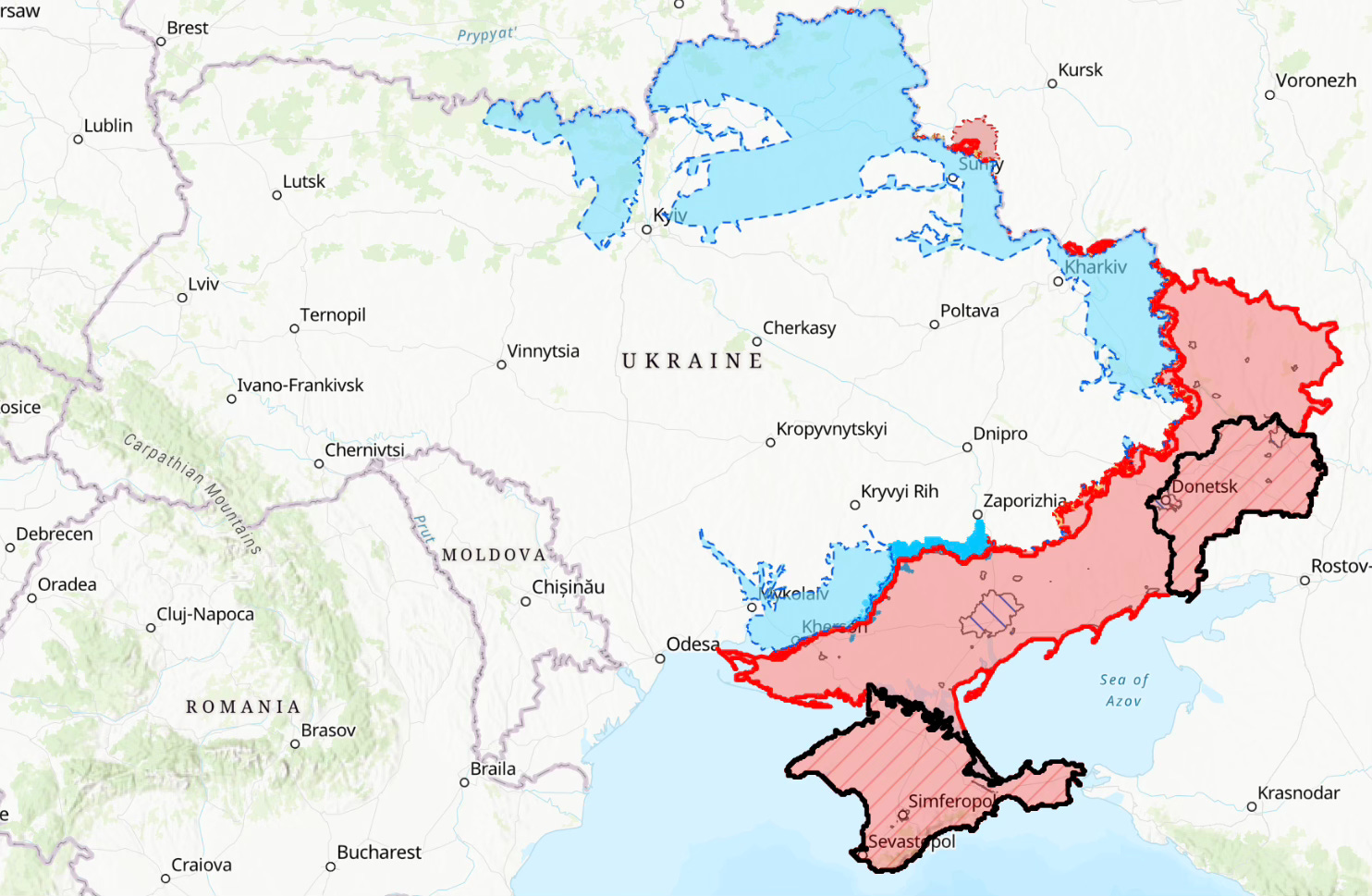
The United States and Russia worked out a 28-point plan to end the Ukraine war, without including Ukraine or Europe in the talks. The deal is very friendly to Russia, framing the conflict in ways that align with Russian propaganda. The U.S. is expected to pressure Ukraine to accept it, but they probably won’t since the deal includes multiple provisions Ukraine previously labeled nonstarters.
I went through the agreement point by point, with deal provisions in bold, and my quick reactions in italics below each.
1. Ukraine’s sovereignty will be confirmed.
This is the biggest “concession” Russia makes, a (passive voice) acknowledgement that Ukraine is a sovereign state, in contrast to nearly four years of Russian leaders saying Ukraine is not a real country and trying to subjugate it.
2. A comprehensive non-aggression agreement will be concluded between Russia, Ukraine and Europe. All ambiguities of the last 30 years will be considered settled.
What ambiguities? I could make some guesses, but the agreement doesn’t say. And why would Ukraine and Europe need to promise non-aggression against Russia? The only aggression this century came from Russia. This reads like “Russia’s many post-Cold War grievances and conspiracy theories deserve validation.”
3. It is expected that Russia will not invade neighboring countries and NATO will not expand further.
This treats European countries entering into a voluntary defensive alliance with each other as equivalent to Russia launching a brutal war of conquest against Ukraine, pretending that both are “aggression.”
4. A dialogue will be held between Russia and NATO, mediated by the United States, to resolve all security issues and create conditions for de-escalation in order to ensure global security and increase opportunities for cooperation and future economic development.
How can the United States mediate a dialogue between Russia and NATO when the U.S. is NATO’s biggest member? In the Kremlin’s dreams, the transatlantic alliance is no more, and the Ukraine war is the great powers of America and Russia settling spheres of influence, like 19th century empires. In Trump, they got an American president to adopt a version of that frame, breaking with previous U.S. leaders of either party.
5. Ukraine will receive reliable security guarantees.
From whom? Made reliable by what?
6. The size of the Ukrainian Armed Forces will be limited to 600,000 personnel.
More specific than most provisions in the deal — which indicates which parts Putin and Trump value most — this would reduce Ukraine’s current military capacity, leaving it more open for a future Russian attack. The agreement calls for no restrictions on Russia’s armed forces.
7. Ukraine agrees to enshrine in its constitution that it will not join NATO, and NATO agrees to include in its statutes a provision that Ukraine will not be admitted in the future.
One of Russia’s big asks is that Moscow gets a veto over Ukraine’s international relationships. The deal calls for enshrining an aspect of that in Ukraine’s constitution.
8. NATO agrees not to station troops in Ukraine.
So there’s no security guarantee, or at least not one with the tripwires that would make it credible.
9. European fighter jets will be stationed in Poland.
Gee, wow, Poland can station its own fighter jets on its own territory, and can give permission to international partners to station there as well. Thanks for the permission, Moscow, but it’s not up to you.
10. The US guarantee:
-The US will receive compensation for the guarantee;
-If Ukraine invades Russia, it will lose the guarantee;
-If Russia invades Ukraine, in addition to a decisive coordinated military response, all global sanctions will be reinstated, recognition of the new territory and all other benefits of this deal will be revoked;
-If Ukraine launches a missile at Moscow or St Petersburg without cause, the security guarantee will be deemed invalid.
The only details about the supposed U.S. security “guarantee” are that the U.S. gets compensation — so it’s more like a protection racket than a security guarantee, and therefore less credible — and things that would end the guarantee, some of which look like potential excuses for reneging in the future. A “decisive coordinated military response” against Russia is not remotely credible. Does anyone seriously believe Trump will bomb Russia if Russia attacks Ukraine again? Or that any U.S. president would? Trump’s predecessor Joe Biden clearly supported Ukraine against Russia, but opposed American or allied forces entering the conflict.
11. Ukraine is eligible for EU membership and will receive short-term preferential access to the European market while this issue is being considered.
Gee, wow, thanks Moscow and Washington, the Europeans have your permission to determine membership in their own organization.
12. A powerful global package of measures to rebuild Ukraine, including but not limited to:
-The creation of a Ukraine Development Fund to invest in fast-growing industries, including technology, data centers, and artificial intelligence.
-The United States will cooperate with Ukraine to jointly rebuild, develop, modernize, and operate Ukraine’s gas infrastructure, including pipelines and storage facilities.
-Joint efforts to rehabilitate war-affected areas for the restoration, reconstruction and modernization of cities and residential areas.
-Infrastructure development.
-Extraction of minerals and natural resources.
-The World Bank will develop a special financing package to accelerate these efforts.
Reconstruction aid would be good. But it’s notable how much the proposal seems to serve American economic interests as defined by Trump and his wealthy backers. The U.S. partially takes over Ukraine’s gas infrastructure, outsiders get access to Ukraine’s minerals, and there’s specific mention of data centers and AI.
13. Russia will be reintegrated into the global economy:
-The lifting of sanctions will be discussed and agreed upon in stages and on a case-by-case basis.
-The United States will enter into a long-term economic cooperation agreement for mutual development in the areas of energy, natural resources, infrastructure, artificial intelligence, data centres, rare earth metal extraction projects in the Arctic, and other mutually beneficial corporate opportunities.
-Russia will be invited to rejoin the G8.
The economic benefits to Russia in the deal are larger than the benefits to Ukraine. Russia gets rewarded for its aggression with instant readmittance to the G8, which kicked Russia out in 2014 after Russia aggressively took Crimea from Ukraine. And Russia gets a cooperation deal with the United States. Once again, data centers and AI get specific mention.
14. Frozen funds will be used as follows:
-$100bn (£76bn) in frozen Russian assets will be invested in US-led efforts to rebuild and invest in Ukraine;
-The US will receive 50% of the profits from this venture. Europe will add $100bn (£76bn) to increase the amount of investment available for Ukraine’s reconstruction. Frozen European funds will be unfrozen. The remainder of the frozen Russian funds will be invested in a separate US-Russian investment vehicle that will implement joint projects in specific areas. This fund will be aimed at strengthening relations and increasing common interests to create a strong incentive not to return to conflict.
Again, reconstruction is good, but the most noteworthy detail is that the U.S. must profit from reconstruction. Europe, excluded from the talks, is expected to contribute money, some of which will go to U.S. profits.
15. A joint American-Russian working group on security issues will be established to promote and ensure compliance with all provisions of this agreement.
More U.S.-Russia cooperation treating Eastern Europe as their imperial sphere of influence. The agreement does not envision any security working group that includes Ukraine or Europe.
16. Russia will enshrine in law its policy of non-aggression towards Europe and Ukraine.
Russia’s invasion of Ukraine and violations of European sovereignty are already illegal under treaties Russia has signed (namely the UN Charter). And Putin’s Russia is not a rule of law society with checks and balances, so writing a non-aggression promise into Russian domestic law means little, especially since the Kremlin often lies that it is a victim of aggression.
17. The United States and Russia will agree to extend the validity of treaties on the non-proliferation and control of nuclear weapons, including the START I Treaty.
Sure, fine. Extending U.S.-Russia arms control treaties would be good. But this is another provision treating a supposed Russia-Ukraine peace deal as merely part of broader U.S.-Russia diplomacy.
18. Ukraine agrees to be a non-nuclear state in accordance with the Treaty on the Non-Proliferation of Nuclear Weapons.
Already guaranteed by the Non-Proliferation Treaty. And by the 1994 Budapest Memorandum, under which Ukraine gave up inherited Soviet nukes in exchange for promises that Russia, the U.S., and U.K. would all respect Ukraine’s territorial integrity. Russia did not.
19. The Zaporizhzhia Nuclear Power Plant will be launched under the supervision of the IAEA, and the electricity produced will be distributed equally between Russia and Ukraine - 50:50.
Ukraine loses control of a nuclear power plant in a part of Ukraine that even this Russia-friendly deal acknowledges as Ukrainian. Russia gets half the electricity it produces.
20. Both countries undertake to implement educational programs in schools and society aimed at promoting understanding and tolerance of different cultures and eliminating racism and prejudice:
-Ukraine will adopt EU rules on religious tolerance and the protection of linguistic minorities.
-Both countries will agree to abolish all discriminatory measures and guarantee the rights of Ukrainian and Russian media and education.
-All Nazi ideology and activities must be rejected and prohibited.
Seems positive at first glance, but to anyone who knows the situation, this part is very Russia friendly. Kremlin lies about persecution of “Russian speakers” in Ukraine was one of its original excuses for invasion. And the Russian government often calls people it doesn’t like “Nazis,” including Ukrainian president Zelensky and various Ukrainian leaders. More than anything, this provision is validation of Russian propaganda, and a potential future excuse for Russia to break the deal.
21. Territories:
-Crimea, Luhansk and Donetsk will be recognised as de facto Russian, including by the United States.
-Kherson and Zaporizhzhia will be frozen along the line of contact, which will mean de facto recognition along the line of contact.
-Russia will relinquish other agreed territories it controls outside the five regions.
-Ukrainian forces will withdraw from the part of Donetsk Oblast that they currently control, and this withdrawal zone will be considered a neutral demilitarized buffer zone, internationally recognized as territory belonging to the Russian Federation. Russian forces will not enter this demilitarized zone.
Incredibly pro-Russia. Ukraine must concede territory Russia currently occupies and some territory Russia has been unable to take. Areas of Ukraine that the Ukrainian military withdraws from shall be considered part of Russia, but officially demilitarized under the agreement. That DMZ could be considered a concession from Russia, but only if one starts from the premise that eastern Ukraine is Moscow’s, so keeping troops out of part of it is giving something up.
22. After agreeing on future territorial arrangements, both the Russian Federation and Ukraine undertake not to change these arrangements by force. Any security guarantees will not apply in the event of a breach of this commitment.
Russia must pinky promise not to attack Ukraine a third time. Plus there’s another warning that security guarantees for Ukraine could evaporate, implying that Russia faced some sort of aggression, which is a lie.
23. Russia will not prevent Ukraine from using the Dnieper [Dnipro] River for commercial activities, and agreements will be reached on the free transport of grain across the Black Sea.
Gee, wow, Ukraine can use a river in Ukraine for commercial activity, and can use international waters for international shipping. Thanks for the permission, Moscow.
24. A humanitarian committee will be established to resolve outstanding issues:
-All remaining prisoners and bodies will be exchanged on an ‘all for all’ basis.
-All civilian detainees and hostages will be returned, including children.
-A family reunification program will be implemented.
-Measures will be taken to alleviate the suffering of the victims of the conflict.
Would be nice, if there were any reason to be confident Russia will follow through. All the language is in future tense, indicating a vision that’s subject to negotiation, including potentially bad faith.
25. Ukraine will hold elections in 100 days.
Ukraine has had to suspend elections while under invasion, so holding a vote would be good, but it’s up to Ukraine, not to the U.S. or Russia. Given that one of Russia’s war aims was ousting the Zelensky government, a quick vote in Ukraine could help accomplish that, while giving Russia an opportunity to manipulate the election similar to its efforts in Georgia, Moldova, and elsewhere.
26. All parties involved in this conflict will receive full amnesty for their actions during the war and agree not to make any claims or consider any complaints in the future.
Russia is absolved of its many war crimes, and the International Criminal Court indictment of Vladimir Putin will disappear.
27. This agreement will be legally binding. Its implementation will be monitored and guaranteed by the Peace Council, headed by President Donald J Trump. Sanctions will be imposed for violations.
So the whole thing is monitored and guaranteed by Donald Trump personally? Does that mean it ends after Trump leaves office? Even before that, he has a long record of what I’ll generously call inconsistency regarding international agreements, so this makes the deal less credible rather than more. There’s a similar provision in the recent Gaza deal, both of which seem aimed more at glorifying Trump than at implementing the hard parts of the agreements, which both mostly leave TBD.
28. Once all parties agree to this memorandum, the ceasefire will take effect immediately after both sides retreat to agreed points to begin implementation of the agreement.
They probably won’t do that. Then what?