

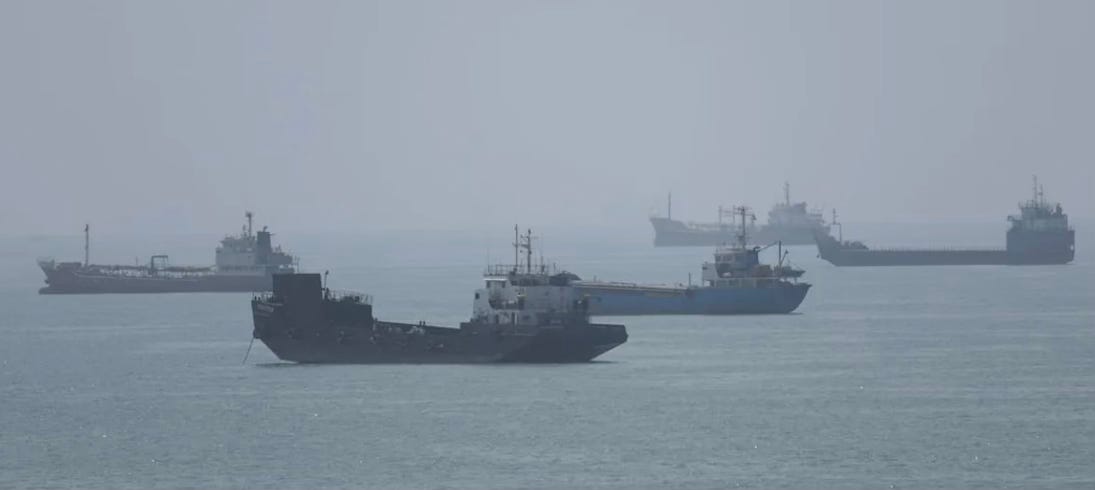
The United States and Iran escalated again, exchanging missile fire and hitting ships, while related fighting in Yemen and Saudi Arabia expanded. More than six months after Trump started the war, and nearly three months after he signed an agreement that would supposedly end it and normalize shipping, the U.S. and Iran are still fighting over the Strait of Hormuz. The damage keeps growing, and the Trump White House is both unable to fix it and unwilling to admit it.
Thanks to Trump’s misguided war, the U.S. and its partners have lost freedom of navigation. The Persian Gulf—a strategic waterway that previously saw the free transit of oil, gas, fertilizer, helium, and other valuable commodities—is now contested. As much as Trump might want to end the war, Iran’s power over Hormuz and ability to keep disrupting the global economy means he can’t. Oil prices are rising again, while gasoline and diesel have both reached record highs. Trump’s party is poised for a rebuke in the upcoming midterm elections, in part because of the failing war. And the White House appears out of ideas, cycling between big threats, limited strikes, and economic pressure, none of which are working.
Trump has been lying that the U.S. controls Hormuz, as if repeatedly saying it can make it real, and bragged that the U.S. Navy is getting 30 ships a day through the strait. Independent ship-trackers record fewer than ten, but ships trying to sneak past Iran likely turn off transponders, so it’s plausible.
But even taking Trump at his word, it’s effectively an admission of failure. Around 120 ships went through Hormuz every day before the war, without naval escort or risk of explosion. Now the U.S. military is spending resources daily—logistically hindered by Iranian fire damaging the Navy’s regional supply ports—just to get a quarter of pre-war shipping traffic.
That’s supposed to be an achievement? That’s the brag?!? At best it’s a recipe for indefinite military operations that slow but don’t stop the accumulating economic damage, not a path to lasting success.
The current White House strategy is a pressure campaign they nicknamed “economic D-Day.” As with Trump demanding “unconditional surrender” at the start of the war, the administration seems to think verbal references to historical American triumphs will yield similarly positive results, despite very different circumstances.
They haven’t.
The U.S. Navy was already blockading Iranian ports, and Iran is under serious economic strain, with reduced oil revenue and rapidly rising food prices, among other problems. But that hasn’t forced Iran into concessions, and probably won’t make the government collapse or capitulate, especially not soon. The Iranian regime doesn’t really care about regular Iranians, and killed tens of thousands during protests earlier this year. Iranian forces aren’t conducting the type of war effort that relies on steady mass production. U.S. sanctions can make life in Iran more uncomfortable, and might force the government to devote more resources to repressing popular unrest, but won’t win the war.
The United States has sanctioned Iran since the 1979 Islamic Revolution, and it didn’t change the regime’s behavior. The one time economic pressure yielded significant concessions was the Obama-era JCPOA, and getting Iran to accept those nuclear restrictions took nearly a decade of UN-authorized sanctions imposed by most of the world’s economies. In Trump’s first term, he reneged on JCPOA and reimposed sanctions, vowing that a policy of “maximum pressure” would force Iran into a “better deal.”
It didn’t.
The result was more Iranian uranium enrichment and eventually war, as I and many others warned at the time. Now the U.S. is attempting sanctions again—extra double maximum pressure?—and hoping for a better result, even though U.S. bombardment and Trump’s lack of credibility makes Iran less likely to deal.
But this time the Trump administration told other countries to sanction Iran too, and threatened U.S. sanctions against them if they don’t. In particular, the U.S. demands that everyone cease all transactions with Iranian banks, and close branches in their countries.
It isn’t working.
China, Iran’s largest trading partner and economic lifeline, officially rejected economic pressure. Russia is deepening trade ties. India isn’t imposing sanctions, and has shrugged off Trump’s economic threats before. Pakistan and Oman haven’t cut off Iran either, and both play significant roles in negotiations over the Strait of Hormuz, so the U.S. is unlikely to punish them. The only country that has really cut financial transactions with Iran is the UAE, which has faced Iranian airstrikes throughout the war.
This failure to generate assistance shouldn’t be surprising. Trump didn’t bother lining up support before launching the war, or even give U.S. allies advanced notice. Those allies have no interest in joining his quagmire now. He has imposed and often threatens tariffs on them, seemingly on a whim. The U.S. “economic D-Day” threat is essentially “hurt your own economy to hurt Iran’s, or we’ll hurt our economy to hurt yours.” Few seem concerned that the Trump administration will follow through.
The president has tried pretending that time is on America’s side, claiming he’s content to wait for Iran to crater. But he’s also been insisting the strait is clear of mines and telling ships to go through.
It probably isn’t and most of them won’t. At minimum, Iran retains the ability to strike ships, and deploy water mines.
One recent U.S. airstrike attempting to counter Iran’s ability to deploy mines hit a wedding celebration, killing at least five. As with the U.S. strike on an elementary school early in the war, this was almost certainly an error, with the bomb aimed at a nearby military target.
But that doesn’t absolve American decision-makers. These things happen in war, yes, but that’s why the choice to start or resume military attacks carries so much weight. Launching another round of bombing risks killing innocents, and turning what should be one of the happiest days of their lives into a nightmare. The fact that the U.S. bombing predictably failed to accomplish anything strategic makes it worse.
Limited airstrikes won’t destroy all Iranian capacity or make Iran give in. Threats won’t get them to make concessions when they’ve already survived large-scale U.S.-Israeli attack, and can see the reports about a U.S. munitions shortage. Economic pressure will at best take time and yield negotiation leverage, not capitulation. The midterms will likely weaken Trump, and Iran can see that too.
We’re looking at an ongoing, costly stalemate, as the president continues trying to lie his way through his massive strategic mistake.