

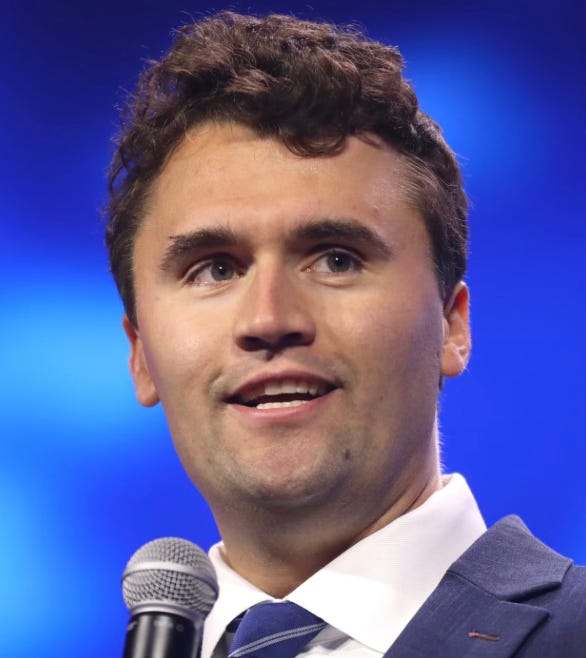
It’s easy to unequivocally condemn the killing of MAGA activist/podcaster/organizer Charlie Kirk as an act of political violence without making up a false version of Kirk to praise. The wrongness of murder does not depend on what I think of the victim’s political views. But New York Times columnist/podcaster Ezra Klein declared that “Kirk was practicing politics in exactly the right way,” going beyond opposing political violence to hold up Kirk as a model. In doing so, Klein accidentally gave the perfect illustration of how America’s mainstream media and liberal elite has facilitated the Trumpian fascism we’re dealing with now.
Charlie Kirk said a lot of bigoted things, spreading hate against Jews, Blacks, immigrants, LGBT people and others. Klein doesn’t defend any of that, or even mention it. Instead he writes, “Kirk and I were on different sides of most political arguments. We were on the same side on the continued possibility of American politics.”
Were they? Charlie Kirk repeatedly lied about the 2020 election, bussed people to Trump’s “Stop the Steal” rally on January 6, 2021, and defended Trump pardoning convicted seditionists by lying that normal court proceedings were somehow denial of due process. Kirk recently celebrated Trump’s illegal military deployments against U.S. cities as “shock and awe” that is “taking our country back from these cockroaches.” Those stances oppose the continued possibility of American politics, at least as a rule of law democracy.
Consider this counterpoint: “to maintain the viability of the American experiment,” political participants need to think “we can live with losing an election because we believe in the promise of the next election.”
You know who wrote that? Ezra Klein. In the very same article he tells everyone to be more like a person who advocated the opposite.
The only contrasting examples Klein gives to Kirk’s “exactly the right way” activities are perpetrators of political violence. And fair enough, those killers practiced politics in a very wrong way. Yet using words rather than violence is a low bar nearly everyone clears. With the exception of a few violent criminals, we’re all doing politics exactly the right way by Klein’s standard — so many of us there’s no problem.
But there is a big problem in American politics: an anti-democracy movement now at the heights of power, engaged in lying, lawbreaking, rights violations, and authoritarian power grabs. Klein doesn’t deny that—last week he urged Congressional Democrats to take a stand against Trump’s abuses—he just denies that the words Charlie Kirk and others used to advocate it are part of the problem. As a result, Klein and the media figures like him have a gigantic blind spot.
The main fault line in American politics shifted from policy disagreement to something more fundamental. It’s no longer material questions—taxes, spending, distribution—which, as impactful as they may be, are things about which reasonable people can disagree. Now the core divide in American politics centers on questions such as: Should powerful people follow the law, even if you personally like them? Should we respect the results of elections? Do we hold the truth “all men are created equal” to be self-evident? Do we hold any truth at all, or do we prefer to live inside a lie, and insist everyone join us?
Charlie Kirk staked out anti-democracy positions on all of those, but Ezra Klein pretends he didn’t. The only specifics Klein offers of Kirk practicing politics in exactly the right way are (1) Kirk and his organization were politically influential, and (2) Kirk held live events on college campuses where he’d argue with students. Both compliments place form above substance, as if the methods of trying to influence people are inherently good, no matter what goals they pursue.
As comedian John Rogers wrote about Kirk’s events, “A 31 year old professional content creator baiting 19 year old amateurs into the format of his choice isn’t debate, it’s crowd work.” Like a stand-up comic messing with a member of the audience, they’re not on equal footing. And the audience member, whether laughing along or heckling, isn’t doing it because they have a fair chance of winning the crowd, but for the experience, the attention, to be a part of the show.
I’m not sure politics needs more debate, with its standards of gamesmanship and sticking to preconceived positions, but Kirk wasn’t really doing that. In part because that’s not his schtick, but also because liberals with a comparable platform, such as Ezra Klein, won’t do it. Debating Kirk would require acknowledging Kirk’s real arguments, calling out the bad faith rather than going with the most generous interpretation. And that they will not do. It would interfere with the fictional character they created. Debating Kirk’s actual arguments is left to the people Klein is scolding, the ones who he implies are doing politics the wrong way.
That leaves us with a massive asymmetry, where Charlie Kirks work against rule of law democracy, Ezra Kleins pretend that they don’t, and together they work to convince everyone that all this is fine, just normal disagreement, so the people taking attacks on democracy seriously are the problem.
It’s reminiscent of professional wrestlers, where some are “faces” the crowd is supposed to cheer and some are “heels” the crowd is supposed to boo, but the show needs both of them. So while they stay in character and act antagonistic in public, they ultimately see each other as colleagues pursuing a joint goal.
It’s hardly just Klein. You can also see it in hagiography extolling Kirk as an adamant defender of free speech who believed everyone should be able to express their opinions without fear of punishment, which is objectively false. He presented himself that way, sure, but he was an anti-speech activist. Kirk ran something called “Professor Watchlist,” where MAGA-minded students reported their professors for wrongthink, working to cancel them for speech.
Making up a fictional Charlie Kirk to praise illustrates the prevailing culture at the heights of many US media institutions. They prioritize process and personal comity over substance. They’re deeply committed to the narrative that America’s two major parties are equal and opposite, prioritizing balance over truth to the point of distortion. And they are adamantly opposed to recognizing bad faith, so they let themselves be used, over and over, in an endless attempt to find reasonable common ground with political forces bent on division.
One example is right-wing activist Christopher Rufo, who publicly announced his intent to “smuggle narratives” into mainstream media, but that did not stop the New York Times, Washington Post, CNN, and others from falling for it. In one of his successes, Rufo launched bad faith accusations against Harvard president Claudine Gay, claiming that paraphrases she wrote over a decade ago constitute egregious plagiarism. The Times made it the biggest story in America, with top headlines for multiple days emphasizing the accusation over the facts, leading to Gay’s ousting.
Individual instances like that have relatively small impacts, but when so much of the media does it, in so many ways, for years on end, it creates a process of normalization. The US right gets more fascist, mainstream figures pretend they didn’t, presenting a fictional version that liberal elites find reasonable. That creates a new baseline, which fascists use to go further, which mainstream media pretends didn’t happen, and eventually it’s like the metaphor of a frog in slowly heating water, failing to notice that things have fundamentally changed until it’s already boiling.
Media leaders hate this critique, and I’ve never seen one address it directly. Instead, they tend to strawman it. For example, Vox founder and Slow Boring editor Matt Yglesias recently dismissed the critique by saying he feels “very confident that tweaking New York Times headlines” will not “convince people who don’t care that much about politics that Trump is bad.”
So there’s no ambiguity: No, I do not think tweaking the wording of some New York Times headlines would single-handedly change millions of disengaged voters’ minds, thereby transforming American politics. I think tons of headlines, framing choices, points of emphasis, uncritical repetition of lies, and presenting bad faith actors attacking democracy as good faith interlocutors practicing normal politics, across professional media for years, all adds up to an impact on vibes, which some voters weigh more than policy. That’s not the only factor, but it’s a relevant one.
Ezra Klein laundering Charlie Kirk’s reputation is just one example of standard media practice for a decade or more, so widespread that it partially laundered an anti-democracy movement, helping bring it into the mainstream and keeping enough people complacent that it took over.
Essentially, editors fell for another bad faith attack: the insistence that gatekeeping is inherently wrong, and nonbias requires institutional neutrality between truth and lies.
But while gatekeeping can be abused, it played a valuable societal role. Much as the Paradox of Tolerance explains how the one thing a tolerant society cannot tolerate is intolerance, a rule of law democracy cannot tolerate lie-based rejection of election results, treating any group as subhuman, or a standard under which one politician can break laws without consequence.
A democratic society needs people in Ezra Klein’s position to treat Charlie Kirk’s anti-democracy stances as disqualifying, rather than pretend they’re just another policy opinion like tax rates. Media leaders are among those responsible for making sure ideas relegated to the dustbin of history stay there.
In this specific instance, the impact is giving people who didn’t know of Charlie Kirk the false impression he was a supporter of free speech gunned down because others can’t tolerate open dialogue. That in turn provides some cover for crackdowns on free speech in Kirk’s name.
But in the aggregate, this glaring media malpractice brought fascists into the mainstream, laundered their arguments, and cultivated complacency the fascists were happy to exploit. And still are.