

Donald Trump is simultaneously more powerful than previous US presidents in frightening ways and a weak leader whose ambitions are stumbling, and it’s important to keep both in mind at once. His outsized power comes from lawbreaking, norm violations, and contempt for US Constitutional democracy, enabled by the Supreme Court majority and Republican-led Congress. His weakness is in his deep and growing unpopularity on every issue—the economy, immigration, free speech, you name it—and limited state capacity.
The Trump regime’s desire for cruelty, corruption, and criminality appears bottomless, but just because they want to doesn’t mean they can. Lacking capacity, they’re trying to bluster and meme their way into consolidated authoritarianism, relying on Americans, especially civil society leaders—in business, media, academia, etc.—to appease threats the regime can’t fully carry out, or do what the regime wants without being asked.
To defeat that sort of regime, push them beyond their limits. Say no to their demands, create friction in their plans, and while you should take the threat seriously, don’t act like they have more power than they do.
The regime took a significant loss when Trump sued the New York Times for a ridiculous $15 billion for publishing things about him that didn’t make him look good. In response, the paper unreservedly asserted its First Amendment rights, and a judge rejected the suit as “decidedly improper and impermissible.”
The New York Times has its problems, but America’s “paper of record” capitulating to such bad faith illegal demands would’ve been a serious blow to freedom of the press and democracy. Other media organizations, lacking the Times’ position and deep pockets, likely would’ve been cowed, and fascists in the executive branch more emboldened.
That’s what happened with a bullying lawsuit Trump filed against ABC earlier this year, with a similarly bad faith accusation of defamation. Disney-owned ABC had a strong case on the facts and the law, but decided to capitulate, agreeing to pay $15 million to a Trump presidential library (a private, not government interest) and $1 million to cover Trump’s legal fees.
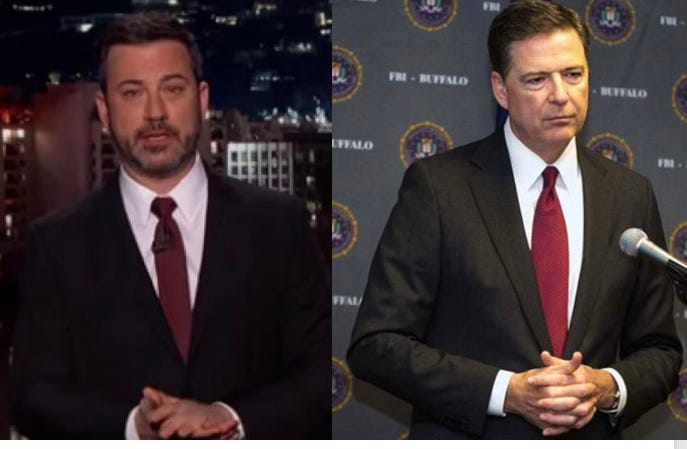
It went how giving in to bullies and appeasing fascists usually goes. ABC showed they’re an easy mark, and Trump came back for more, this time demanding the ouster of late night comedian Jimmy Kimmel, supposedly over something Kimmel said about the murder of Charlie Kirk.
Again Disney opted for appeasement, pulling Kimmel off the air. This wasn’t cancel culture it was state censorship, with FCC Chair Brendan Carr publicly telling Disney to “take action on Kimmel,” threatening “we can do this the easy way or the hard way.” Back in July, Trump celebrated CBS canceling Late Night with Stephen Colbert by crowing “Jimmy Kimmel is NEXT,” saying he hoped to play “a major part” in getting Kimmel off the air, so it’s clear Charlie Kirk’s murder was a pretext. Kimmel hadn’t made a joke at Kirk’s expense, and even if he had, that would be First Amendment protected speech.
It looked like an authoritarian moment, another line crossed in America’s backslide away from democracy, recalling Russia’s Vladimir Putin canceling a satirical puppet show, or Joseph Goebbels silencing comedians who made jokes about the Nazis.
Until it wasn’t. America reacted negatively to the overt attack on free speech, with comedians, celebrities, politicians, even Republican Senators Ted Cruz and Mitch McConnell speaking out. The incident reached into non-political information streams, and was widely unpopular. An Economist/YouGov poll found that 90% of Americans had heard Kimmel was taken off the air, and 68% say it’s “unacceptable for the government to pressure broadcasters to remove shows that include speech it disagrees with.”
The negative reaction appears to have surprised MAGA operatives who, in their information bubble, believed Charlie Kirk was nationally beloved. Sinclair, a right wing media company that owns about 16% of ABC affiliates, tried to extort Kimmel, demanding not only an apology as a condition to return to the air, but also a donation to Kirk’s political organization Turning Point USA.
But canceling Kimmel created a Streisand Effect, drawing millions more eyeballs to his show, including its YouTube page, which TV affiliates can’t touch. And Kimmel used the attention to stake out the old-fashioned American idea of a free country, where we won’t all agree, but the government shouldn’t force anyone to shut up, especially not for making fun of political leaders.
Disney executives may have preferred capitulation, thinking censorship under state pressure the easier path. But consumers canceling Disney+ subscriptions and Disney park vacations, and some big Hollywood names—producer Damon Lindelof, actor Pedro Pascal, etc.—siding with Kimmel created counterpressure, enough that ABC changed course within a week. Sinclair held out, airing reruns of Family Feud in the timeslot. But a few days later, perhaps feeling pressure from advertisers, they put Kimmel back on.
Rejecting the First Amendment, President Trump said “you have evening shows and all they do is hit Trump, they’re licensed, they’re not allowed to do that.” But apparently they are.
Legally there’s no question comedians can make fun of the president and his associates, but in Trump’s second term, the United States has often placed his whims above the law. That’s a choice. A series of choices, really, by people throughout society, especially influential elites, adding up to a cultural shift away from rule of law democracy.
However, a significant factor is people going along with Trumpist authoritarianism because they think that’s the way the winds are blowing. The less they think so, the less they will act like it. It’s a self-fulfilling prophecy either way.
Trump will likely keep abusing power to try to silence critics, whether Kimmel again or others. But whatever else happens, this time he lost, a core Constitutional principle won, and a lot of Americans saw it. The threat is serious, but he’s weaker than he looks.
That’s also the way to view another big line-crossing, prosecuting public figures Trump sees as political enemies.
Seeking to carry out Trump’s corrupt demand for personal revenge, the Department of Justice (DOJ) assigned US Attorney Erik S. Siebert to investigate and charge New York State Attorney General Letitia James (who brought and won a fraud case against the Trump Organization in civil court, resulting in business penalties and fines) and former FBI Director James Comey (who in 2017 refused to put personal loyalty to Trump above his legal duties, and has occasionally criticized Trump in public). A federal prosecutor since 2010, Siebert has a successful record and good reputation, becoming an acting US Attorney early this year with bipartisan support.
Despite months of investigation, Siebert found no evidence against James, and such weak evidence against Comey that Siebert determined a conviction was unlikely, declining to bring the case as per standard DOJ procedure. So Trump pushed Siebert out and replaced him with Lindsey Halligan, an insurance lawyer and White House staffer who had been tasked with censoring the Smithsonian museums. In her first-ever prosecution, Halligan quickly moved to indict Comey.
And what a weak charge it is. The only indictments Halligan could get from a grand jury—by a tighter-than-usual 14 out of 23 votes—accuse Comey of lying under oath to Congress in 2020 when he said he did not authorize a leak to the press about the FBI’s Hillary Clinton email server investigation in 2016. That’s it. And there’s a decent chance Comey didn’t do even that, with the accusation based more on conservative media spin than facts.
A special counsel, John Durham, already conducted a multiyear investigation seeking to validate right-wing conspiracy theories about the FBI supposedly victimizing Trump in 2016. Durham came up nearly empty, with few charges, two embarrassing acquittals, and just one conviction against former FBI lawyer Kevin Clinesmith for putting false information in an email. All Clinesmith got was probation.
It’s an awfully weak case to cross the line of prosecuting a former FBI Director. As the New York Times frames it, this “shatters norms” and “trampled over the Justice Department’s long tradition of keeping a distance from politics and the White House.” But that’s the point. The Trump DOJ isn’t doing law enforcement, they’re pursuing personal revenge and authoritarian dominance.
The Comey prosecution shows that Trump will abuse power to go after Americans he hates when the facts, laws, and norms are against him. Even assuming that Comey wins in court, the case will cost him time and money. It will likely chill speech, especially from people less able to fight back than Comey.
In rule-of-law-democracy terms, that’s very bad. But in resistance-to-authoritarianism terms it’s not.
DOJ now has fewer prosecutors who were good at securing convictions. Losing Siebert adds to a growing list that includes prosecutors Attorney General Pam Bondi purged from DOJ for investigating and convicting criminals who attacked Congress on January 6, 2021. And the prosecutors who resigned rather sign on to a corrupt deal that dropped a strong bribery case against New York City Mayor Eric Adams. And the US Attorney Trump recently fired for telling the Border Patrol they have to follow court orders. Plus more.
Prosecuting cases requires personnel, securing convictions requires competence, and DOJ has less of both, limiting how much harassment they can do on Trump’s behalf. And Lindsey Hannigan—one of the few attorneys willing to bring frivolous, norm-shattering charges—will be busy with a prominent American who will fight back.
Comey presumably didn’t want to face harassing prosecution, but appears to be revelling in the chance to play this role in American history, releasing a video statement unequivocally asserting his innocence and extolling the virtues of impartial justice. For his legal defense, Comey got Patrick Fitzgerald, who served as a US Attorney under both George W. Bush and Barack Obama, succeeding in high profile cases against terrorists, corrupt politicians, and others.
With multiple public statements from Trump indicating this is a selective, politicized prosecution, Comey has a good chance of beating the charges, and at minimum will tie up some of the regime’s prosecutorial and propaganda capacity. That reduces their ability to go after other political enemies, and could make some American elites more willing to stand up for themselves.
Under a consolidated authoritarian regime, there’s no way Comey could win in court, and the government might’ve just disappeared him, rather than go through judges, grand juries, and trial juries. America has been heading in that Putinist direction, which is incredibly serious, yet the country is not nearly as close to it as Trump and his allies—and a lot of US media—pretend. Recognizing that will help prevent it.
Comey won’t be the end. Trump’s corrupt DOJ will go after more of his targets. But there won’t be many prosecutors willing to bring frivolous cases, and public opinion will continue to sour, especially if they go after popular figures known outside politics like Jimmy Kimmel.
And all the while, the regime is spending its limited resources, exposing how much it needs people to fall for the show.
Thank for you for this. I needed this encouragement.