

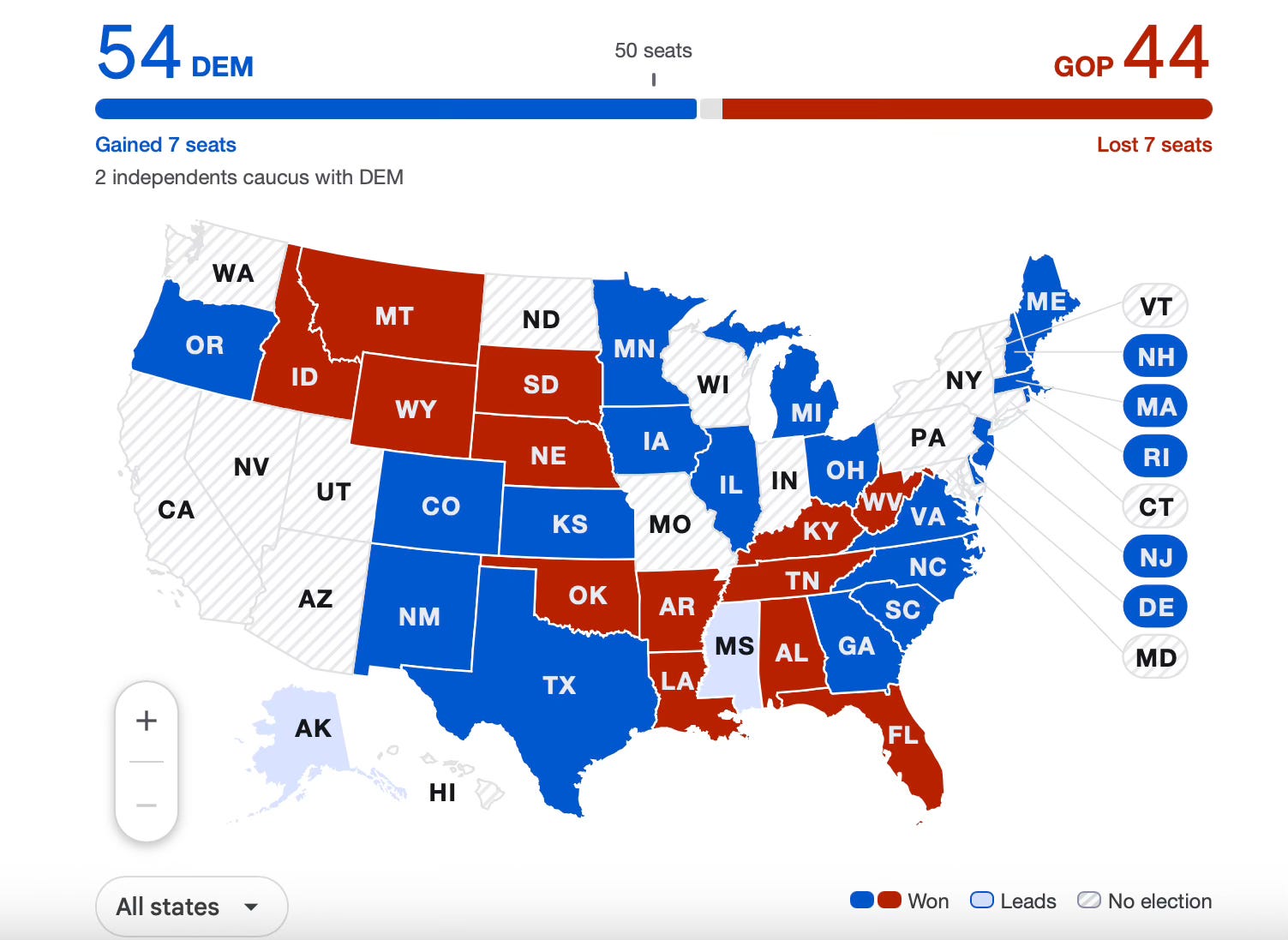
The midterm elections went great for Democrats—and terribly for Trump and the Republicans—better even than most pro-democracy observers dared hope. Democrats won the House and Senate by sizable margins, and made large gains at the state level as well. America’s democratic backsliding under Trump isn’t over, and will probably get worse, but these midterm results mean a significant shift in institutional power, and a symbolic rebuke to Trump’s misrule. Now Democrats must use the power they won.
The most watched and nationally significant races were for the Senate, and Democrats ran the table. They won Senate elections in Georgia, North Carolina, and Ohio, all of which Trump won in 2024.
Democrats won in Michigan, where Senate candidate Abdul El-Sayed overcame Trump, Vance, and the Republicans incessantly smearing him because he’s Muslim, trying to paint him as a dangerous jihadist with guilt by association to foreign groups he doesn’t associate with.
Democrats won in Maine, ousting longtime incumbent senator Susan Collins. She was the only Republican who won a Senate seat in 2020 in a state that went for Biden, and did so despite controversy over her confirmation of Supreme Court Justice Brett Kavanaugh.
Democrats won big in Texas, beating the polls. James Talarico will be the first Democratic Senator from Texas in decades, despite hundreds of millions of dollars in bigoted ads from Elon Musk telling Texans that Talarico would “trans your kids.” Gina Hinojosa will be Texas’ first Democratic governor this century and first Latina governor ever, and will play a nationally influential role in immigration, trade, education, and more. Egregious racist Bo French lost the race to oversee the state’s oil and gas industry, adding to the symbolic rebuke. Texas isn’t blue—Republicans should be considered the favorite there in 2028, given the different dynamics of presidential elections—but after these midterms it looks purple, which will make Republicans, especially right-wing culture warriors, nervous.
Democrats won in Kansas, which hasn’t had a Democratic Senator in nearly a century.
They won in South Carolina, and Mississippi is too close to call. If you predicted Democratic wins in either deep red state a year ago, pundits would’ve laughed in your face. But Black voters reacted to the Supreme Court gutting the Voting Rights Act and allowing racial gerrymanders by turning out in droves, and some white southerners appear to have swung away from Republicans.
Some commentators will find ways to downplay these results. South Carolina Republican Senate nominee Darlene Graham was wildly unqualified, selected only because her brother Lindsey Graham died in office, and a better nominee might have won. Kansas’ incumbent Republican Senator Roger Marshall closed his campaign by defending his exploitative financial practices from when he was a doctor. Texas Senate candidate Ken Paxton is a blatant crook.
The Republican candidates were bad and the national conditions were worse. Some Americans voted against high gas prices, and would have stuck with Republicans if Trump hadn’t attacked Iran. The midterm results do not decisively prove that a majority of American voters agree with center-left or left-wing policies. If the economy were doing better, the president’s party probably would have lost fewer seats.
But that doesn’t really matter. It’s all Trumpism. The president’s illegal war and illegal tariffs are part of his assault on Constitutional democracy. So is his corruption and fixation on monuments to himself. So are his many rights violations, including ICE raids, censorship of critical speech, and attempts at voter suppression. So are his racial, gendered, and political purges of the military and other parts of government. The whole package is inseparable, and anyone voting against part of it effectively voted against all of it.
The Democratic win is so big that most media is treating it as a rebuke to Trump, rather than any sort of mixed result. The win is so big that some leaders in business, tech, media, academia, and other institutions that supported or appeased Trump’s authoritarianism will get nervous that they made a mistake, and fewer will break norms or laws at his demand going forward. The supposed “vibe shift” from 2024, which was always exaggerated and already undermined by the 2025 elections, is done. And the midterm results will likely prompt Republican infighting, as some blame Trump for the loss and others defend him with cultish devotion.
The results were so big that Trump isn’t challenging them. The president had been lying about fraud for months—years, really—laying the ground to try to overturn a narrow midterm loss. But a few hours into election night, Trump said he’d accept the results and will “work with the Democrats… we’ll probably work something out.”
He’ll drop that conciliatory tone soon. It’s an attempt to shrug off the big loss and get media narratives to move on, not a preview of the future. But still, it’s better than dragging the country through another lie-based assault on election integrity.
For now, Trump is focused on deflecting responsibility. When pressed by Fox News’ Bill Baier about saying “pretend I’m on the ballot” at rallies, Trump blamed the Republican candidates for losing and insisted “I wasn’t on the ballot.” This validates the argument I made at the start of this year that, unlike in 2020, Trump wouldn’t go all out trying to steal the midterms, because he’s not personally at risk.
But make no mistake, he tried hard to keep Republicans in control of Congress. In addition to campaigning, Trump has abused power in multiple ways to put the government’s thumb on the scale in his party’s favor, rendering the election less than fully free and fair. But the vote still happened, with very high turnout, and the people prevailed.
Now the Hard Part
Winning the midterms by a sizable margin is the best thing Democrats could’ve done to counter Trump’s assault on Constitutional democracy. With the majority in both houses, they can investigate and expose Trump regime corruption, lawbreaking, and abuses of power. The House can impeach Trump officials, starting with Pete Hegseth for war crimes. Impeachment probably won’t result in removal, due to Republican protection in the Senate, but will still increase investigatory powers, draw media attention, and take up some of the regime’s time. Meanwhile in the Senate, Democrats can end confirmations for Trump judges and administration officials.
The biggest power Democrats won is over the federal budget. The Trump White House, especially Elon Musk’s DOGE and OMB Director Russel Vought, have partially usurped Congress’s power of the purse, repeatedly violating Article I of the Constitution and the Impoundment Control Act of 1974. They’re illegally blocking spending allocated by Congress, and spending on things that Congress didn’t authorize. And yet, the White House still got panicky as the 2025 government shutdown dragged on, needing Congress to pass a budget.
Democrats should use their midterm-provided leverage to fight Trump’s abuses of power. For example, refuse to pass a budget unless Trump fires Vought (because what’s the point of passing a budget the White House won’t follow?) Use leverage over the military budget to demand an end to the illegal, failing Iran war and the illegal, strategically pointless campaign of bombing boats in the Caribbean and Eastern Pacific.
There are many possibilities, and multiple things should be done at once, but whichever Democrats choose to prioritize, they should see themselves as an opposition party. Their mandate is to check a corrupt, criminal president, not to somehow become responsible for governing despite White House abuses.
The midterms wrested some institutional power away from Republicans, flipping Congress from enablement to opposition, but that won’t fix America’s many Trump-driven problems. We’re too far gone, and backsliding too fast, for a Congressional election to turn things around.
Trump might bomb Iran again soon. There’s no possible deal besides a humiliating American surrender, and Iran isn’t going to soften its position in response to Trump losing some power at home. The president will be coping with feelings of weakness after the electoral rebuke, and the White House will find appeal in changing headlines from “Democrats Win” to “Trump Strikes Iran.”
After Democrats take control of Congress in January, the White House will defy Congressional authority, stonewall Congressional investigations, and violate the Constitution in numerous ways, possibly worse than ever before. While Democrats will have more power to contend with that, they’ll still be at a disadvantage to a lawbreaking executive branch.
And then there’s 2028, where Democrats first need to win the vote despite Trump and Vance abusing power to tilt the election to the Republican nominee. Then Democrats, pro-democracy Americans more broadly, and whatever’s left of U.S. institutions will probably have to overcome a coup attempt. Trump and Co. tried last time they lost a presidential election, and ended up more rewarded than punished, so they’ll likely try again. They’ve had years to think about their 2020-21 failure, they’re more above the law now, and tech oligarchs such as Elon Musk—who’ve gotten a taste of national power, and might go to jail or at least lose a lot of money if their corrupt Republican allies lose office—will have greater incentive to help. That shouldn’t be, it’s very wrong, yet here we are.
Does that sound like a downer, dampening what should be a positive moment? If you’re still in a normal democracy mindset, it probably is. But America hasn’t been a normal democracy for almost two years now, and by the standards of democratic backsliding we’re doing pretty well. The regime’s efforts to consolidate authoritarianism have mostly failed, and failed to a greater degree than most people expected at the start of 2025.
But most, probably all of these problems would’ve still happened if the 2026 election were closer, or if voters validated Trumpist misrule by keeping his party in charge of Congress. And it likely would have been worse. This is an excellent midterm result, putting pro-democracy Americans in better position to fight back against the anti-democracy actions to come.
Things will get worse before they get better. But this repudiation of Trumpism is a good sign that America will get out of this.
Looking at the political map after yesterday, for me the biggest change is the new shape of the Democratic Party's constituency. The GOP was MAGA going in and it is MAGA coming out. But the Democrats now have more energetic and intelligent elected leaders as senators, governors, or both in politically traditional states like Iowa and Kansas in the midwest; Georgia, South Carolina, and Texas in the South.
I think Democrats have been in the last few cycles something like a regional party, overwhelmingly representing the electorates in the Northeast, Rust Belt (their weakest buckle), and West Coast. Now the Party has a strong stake in electorates in the Breadbasket Midwest and Deep South (even Florida just of reach and . . . Mississippi(?!) perhaps within reach). It has promise to become a national party as it was under for a decade after New Deal and during the Civil Rights era. This means a major change in the center of gravity within the Party itself, with major implications for policy priorities and configurations sharing broadly common aspirational goals.
I'm hopeful that what we'll see as a result is a party where multiple viewpoints are in a perpetual state of common negotiation, rather than congealing as ideologically pure party factions, contesting with a "my way or the highway" battle for "the soul of the Party."