

Visiting family in Maryland for the holidays, my wife and I decided to take our kids into Washington DC for a few hours to see some monuments. Before moving to the midwest for work, we lived in DC for five years—in Adams Morgan, if you’re curious—and the trip down memory lane was nice, but when we got to the National Mall, it was weird. I saw signs of, and couldn’t avoid thoughts about, the second Trump administration shifting the United States away from democracy in the direction of personalist dictatorship.
We went to the Lincoln Memorial, and my 4th grader recognized the steps as the spot Martin Luther King Jr. delivered “I Have a Dream.” I couldn’t help but think of Trump, self-styled “Secretary of War” Pete Hegseth, and other officials taking steps to resegregate the government, and the Stephen Miller-led deportation campaign cracking down on many non-criminals without even attempting due process. America’s leaders are judging people not by the content of their character, but by the color of their skin.
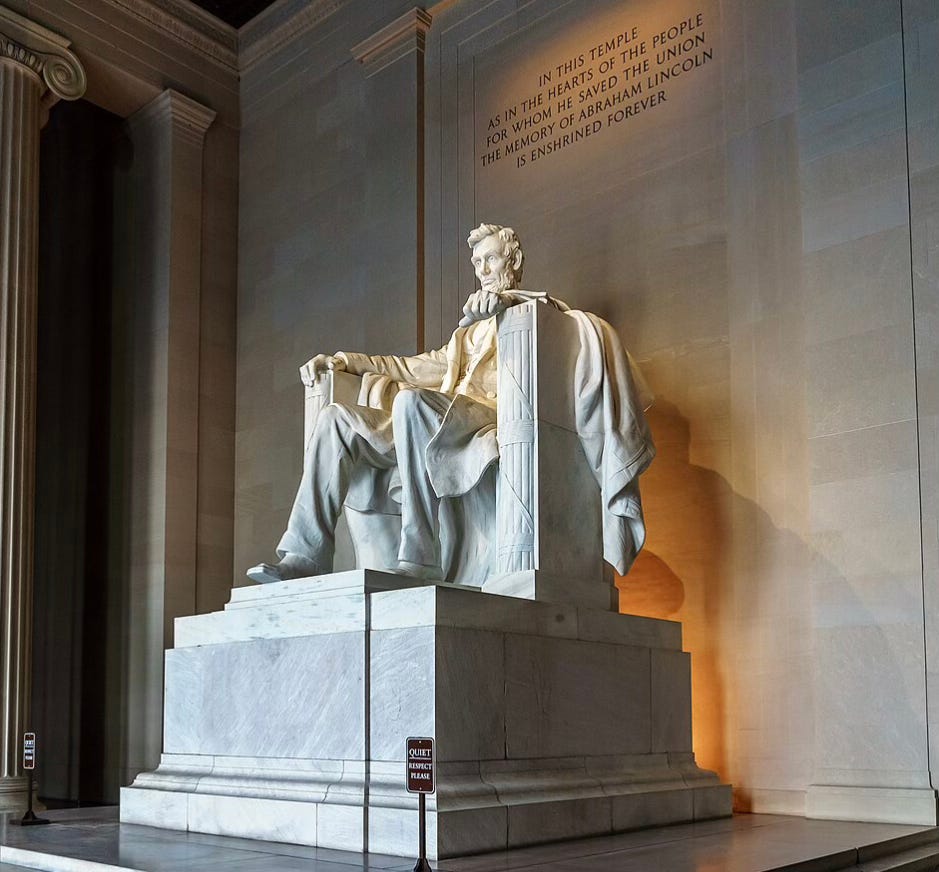
Walking inside the secular temple to America’s other greatest orator, we saw carved into the walls Lincoln’s most famous speeches. I’ve read these words many times, but they took on new meaning, sad yet determined in a way that felt current, not only historic.
There’s the Gettysburg Address:
We here highly resolve that these dead shall not have died in vain — that this nation, under God, shall have a new birth of freedom — and that government of the people, by the people, for the people, shall not perish from the earth.
And the second inaugural:
With malice toward none, with charity for all, with firmness in the right as God gives us to see the right, let us strive on to finish the work we are in… to do all which may achieve and cherish a just and lasting peace among ourselves and with all nations.
Breaking the tension the way only kids can, my 1st grader asked if Lincoln really was as big as the statue.
We walked past some kitted-up National Guard troops, standing in a clump doing nothing, deployed by the president based on lies to assert authoritarian power. The 1st grader asked if they were from a war, and after acknowledging that he was right about the uniform, I said no and mumbled something about how they shouldn’t be here, then changed the subject.
We went past the Korean War memorial, including photos honoring American troops for helping rescue refugees, something the Trump administration despises. Next was the World War II memorial and its unifying, antifascist imagery.
From the Washington Monument, near where I stood with 1.8 million freezing people for Barack Obama’s 2009 inauguration, my family looked at the Capitol, the first time I saw the building in person since the January 6 attack. The appearance is the same, but it felt different, the site of an insurrection I now teach about in my course on terrorism and insurgency.
The night before I moved out of DC in 2013, I walked around the Capitol, admiring its physical and symbolic beauty. Now I know details of the grounds and entrances like Civil War reenactors know the fields of Gettysburg.
We turned and walked past the White House—”looks like the pictures,” said my 4th grader—and I was glad that, from our angle, we couldn’t see the construction site where the East Wing used to be. Trump illegally tore that down for a tacky ballroom, which the administration assures everyone is being built with money from corporations, not taxpayers, as if being funded by bribes makes it better.
At this point, the kids were getting tired, and we circled back to the car, walking past the National Endowment for the Arts and National Endowment of the Humanities, which Trump is devastating with illegal cuts. Our route out of town took us by the Kennedy Center—which Trump renamed after himself, also in violation of the law—with its weirdly awkward new lettering saying “The Donald J. Trump and The John F. Kennedy Memorial Center for the Performing Arts.”
Seeing all this in person bothered me more than I expected.

But despite all that, I’m feeling pretty optimistic heading into 2026. It all depends on your perspective. In normal liberal democracy terms, the United States is in bad shape. But in consolidated authoritarianism terms, we’re doing pretty well.
I flipped that mental switch after the 2024 election, evaluating America by how fast it was backsliding. For the first few months of Trump’s second term, things went downhill fast. The regime grabbed more power, Republicans enabled it, Democrats reeled from their electoral loss, and some societal leaders, most prominently tech billionaires, rushed to embrace the new corrupt order.
But as the year progressed, signs emerged that the regime missed its chance to permanently end American democracy. The near future will be tough, but I’m taking solace in these three things:
1—This Could Have Been Popular
In 2024, Trump had his best electoral showing ever, winning the popular vote for the first time after running as a convicted criminal opposed to rule-of-law democracy, with his most explicitly white nationalist campaign yet. In office, he’s corrupted federal law enforcement, usurped Congress’s power of the purse, shifted foreign policy in Russia’s favor, broken a lot of laws, and sent ICE to violate rights. And the American public could’ve been into it.
But they’re not. Obviously some are, but far from a majority. Trump’s approval rating has declined, and he’s underwater on just about every issue. Big “No Kings” protests and Democratic victories in the 2025 elections showed that Trump’s 2024 win was specific to that year’s circumstances—inflation, a global anti-incumbent wave, etc.—not a lasting societal shift.
As frustrating as this may be for people who follow politics and take it seriously, millions of Americans voted for Donald Trump believing that he wouldn’t do the things he kept saying he’d do. That wasn’t a majority of his supporters, but still a significant, election-swinging subset. Now that they’ve seen it in practice—now that they’ve touched the stove—they don’t like it.
2—We Could Have Had Smarter Fascists
Popular support gives would-be dictators room to operate, but the Trump regime’s haphazardness and corruption has done the opposite. The smart move would’ve been throwing economic benefits at the public, especially supporters, while consolidating institutional power behind the scenes.
Instead, Trump and Co. have raised prices with tariffs, raised unemployment with illegal firings and macroeconomic uncertainty, harmed tourism with harassment of foreigners, and undermined healthcare for millions of Americans in ways that are unignorable and likely to get worse. They’ve been so blatant with lawbreaking that they’ve gotten numerous rebukes in court, sometimes even in front of judges inclined towards deference. And their culture-warring has been so heavy-handed that it’s prompted backlash.
For example, the regime and its allies went on a bout of censorship after the killing of Charlie Kirk, and did get some people fired or suspended for speech, but faltered in their public push to get comedian Jimmy Kimmel off the air. More recently, artists have been canceling Kennedy Center performances, and Trump-installed director Ric Grenell has been sputtering about suing them, prompting more to cancel.
3—Limited Capacity
In ways large and small, the United States has seen serious democratic backsliding. But while the Trump regime’s desire for authoritarian dominance is bottomless, its capacity is not. They’ve reduced their own law enforcement and prosecutorial capabilities with political purges and pursuit of personal vengeance. Even as they damage the U.S. Constitutional system, they show their limited ability to assert undemocratic control.
One example is ICE and Border Patrol. They’re hurting people—including legal residents and citizens—violating rights, and imposing a climate of fear in their “mass deportation” campaign. But notice how they pop up in one city at a time, then mostly leave? And how they’ve been frustrated by concerned communities following them with whistles?
Combined, ICE and Border Patrol have maybe 50,000 active officers. Despite low standards and increased funding, they’ve struggled to recruit more. In the United States, there are many jobs for competent people interested in law enforcement, and there aren’t that many Americans who want to brutalize nannies at the playground, daylaborers in a parking lot, or parents at school drop-off.
By comparison, the Nazi SS had about 250,000 members in 1939, before Hitler invaded Czechoslovakia and Poland. Unemployment in 1930s Germany cracked 25%, and more than a third of young men were out of work. Even with Trump’s economic damage, unemployment in the U.S. currently sits at 4.6%, a post-pandemic high, but nowhere close to the Great Depression. 2020s America doesn’t have the bitter legacy of World War I, and interwar Germany didn’t have video games or social media.
The fact that I’m making serious comparisons to Nazi Germany highlights how bad things have gotten. And it also shows how much worse they could be. It’s important to keep both of those in mind at once, not growing complacent, nor excessively despairing.
America is in bad shape, as I couldn’t avoid thinking about while walking the National Mall, and will probably get worse. But after this difficult year it looks like the regime doesn’t have it. A lot of America is resisting, and there’s a good chance we eventually get out of this, albeit not without more pain.
A note to Arc Digital readers:
I write to be read, and greatly appreciate all of you who engage with my articles, and especially those who share them, online and off. And because I want as many people reading as possible, I avoid putting things behind a paywall or otherwise restricting content to paying members.
But this, as you can imagine, is not a good way to get paying subscribers. The standard practice is to make about half of the articles members-only, but I don’t want to do that, preferring to keep things I write for Arc and elsewhere available to all.
So if you’ve gotten something out of my writing, please consider tossing some coins in my jar by upgrading to a paid subscription if you are in position to do so. That gives you the ability to leave comments, which I always read and often respond to, but primarily, it will keep nearly everything I write free to read.
Happy New Year. I’d say something like “here’s to a better 2026,” but as you can tell from this article, I’m not sure if that’s in the cards. So here’s to staying sane in 2026, in no small part from solidarity with each other.
Regards,
Nick
Thanks for the article. Those are three good points to think about. I am not as optimistic as you are. The Republican party has become a party of cowards who will go along with anything the administration does. The Democratic party seems to be too worried about how to peel off a few voters to stand up to things forcefully. That said I still have hope (if not optimism).